Inside Clash Royale's Economy
How rewards, upgrades and paid acceleration shape progression.
- Problem
- More rewards do not always translate into usable upgrades or more room to try different decks.
- My contribution
- I examined progression through my account observations and made design judgments, with research, editing and visual-production assistance.
- Finding and proposal
- In the observed account, Gold became a constraint on experimentation. The analysis proposes testing changes; it does not establish an optimal Gold increase or a result for every player.
Currencies
Clash Royale's economy is not built around one currency. It is a chain of specialized resources with different jobs. Cards and Wild Cards satisfy the copy side of an upgrade; Gold pays the universal cost that turns those copies into card levels. The card's rarity changes the number of copies required, but the Gold cost follows the destination level, making it a shared cost across the collection. Hero Coins unlock Heroes, Evolution Shards unlock Evolutions, Gems buy shortcuts, Trade Tokens exchange unwanted cards for wanted ones, and Crystals and Star Points convert surplus or long-term play into cosmetic progression.
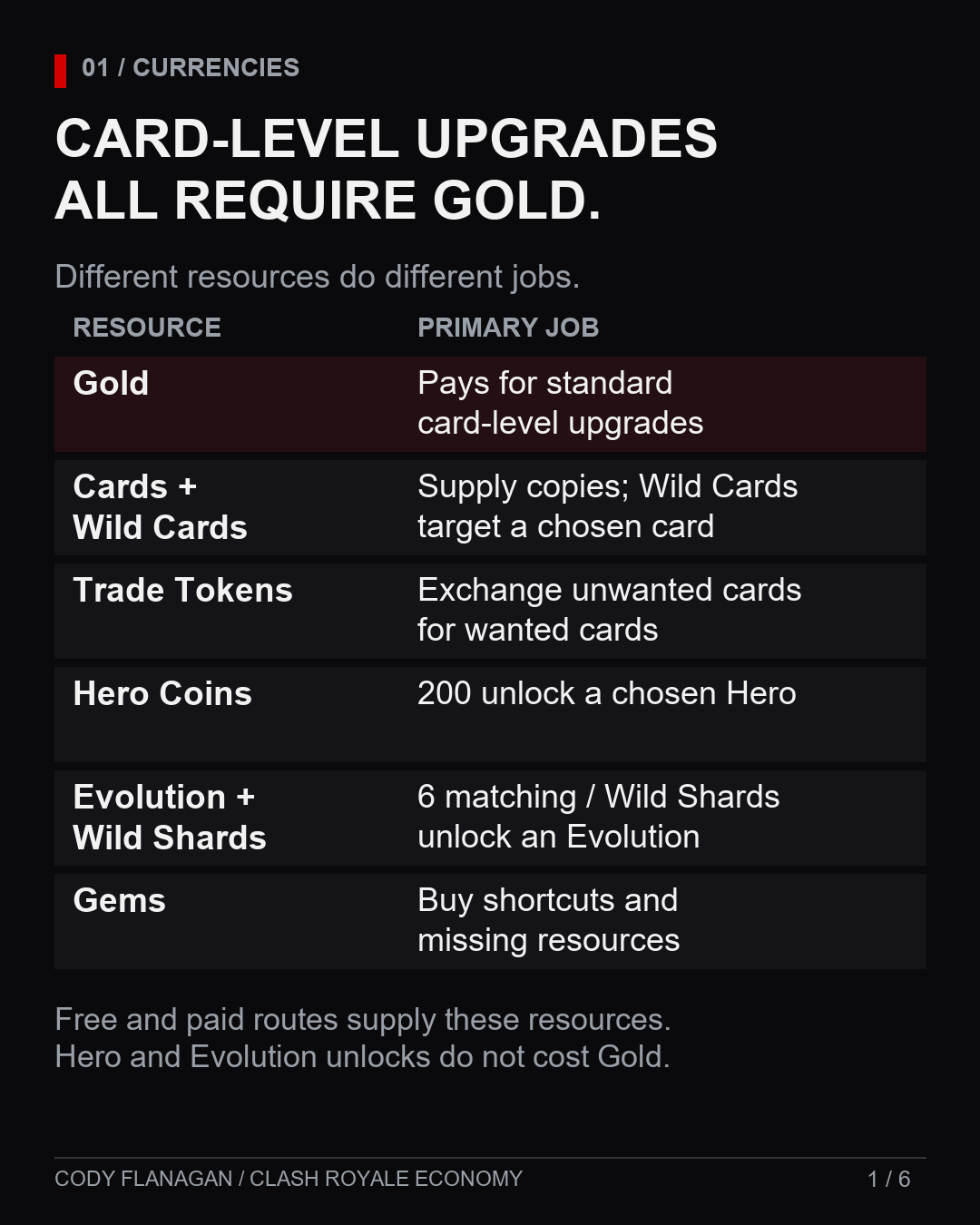
Three conversions make the structure legible. Every standard card-level upgrade requires enough copies plus Gold. Two hundred Hero Coins unlock a Hero of the player's choice, while six Evolution Shards unlock an Evolution. Heroes and Evolutions are enhanced card forms with additional abilities. Wild Cards and Trade Tokens give players control over which cards move forward, while Hero Coins and Wild Shards let them choose which new form to pursue. Across the system, resources enter through free play, reward tracks, the Pass, and the Shop, but not at equivalent rates.
On my account, Gold is where that flexibility runs out. I choose which ready card receives an upgrade, but the other resources I collect do not give me enough Gold to clear the queue. Another card reward can complete the copy requirement without making the upgrade affordable. That is a shortage I experience, not a claim that every account has the same limiting resource.
That is why Gold-heavy special offers can sometimes feel appealing even when most à-la-carte purchases do not. For my standard card upgrades, Gold is the resource that makes the next level possible. Hero and Evolution unlocks follow their own resource requirements without a Gold payment.
Resource rules come from Supercell. The Gold shortage and appeal of Gold-heavy offers describe my account and experience.
Cards and decksTrading cardsHeroesCard EvolutionMagic ItemsGold & Card Upgrades
Owning a card and keeping it competitive are different costs. A standard card-level upgrade requires enough copies—either direct copies or Wild Cards—and Gold. Rarity changes the copy requirement, but from Level 11 forward, every rarity meets the same Gold price at each destination level.
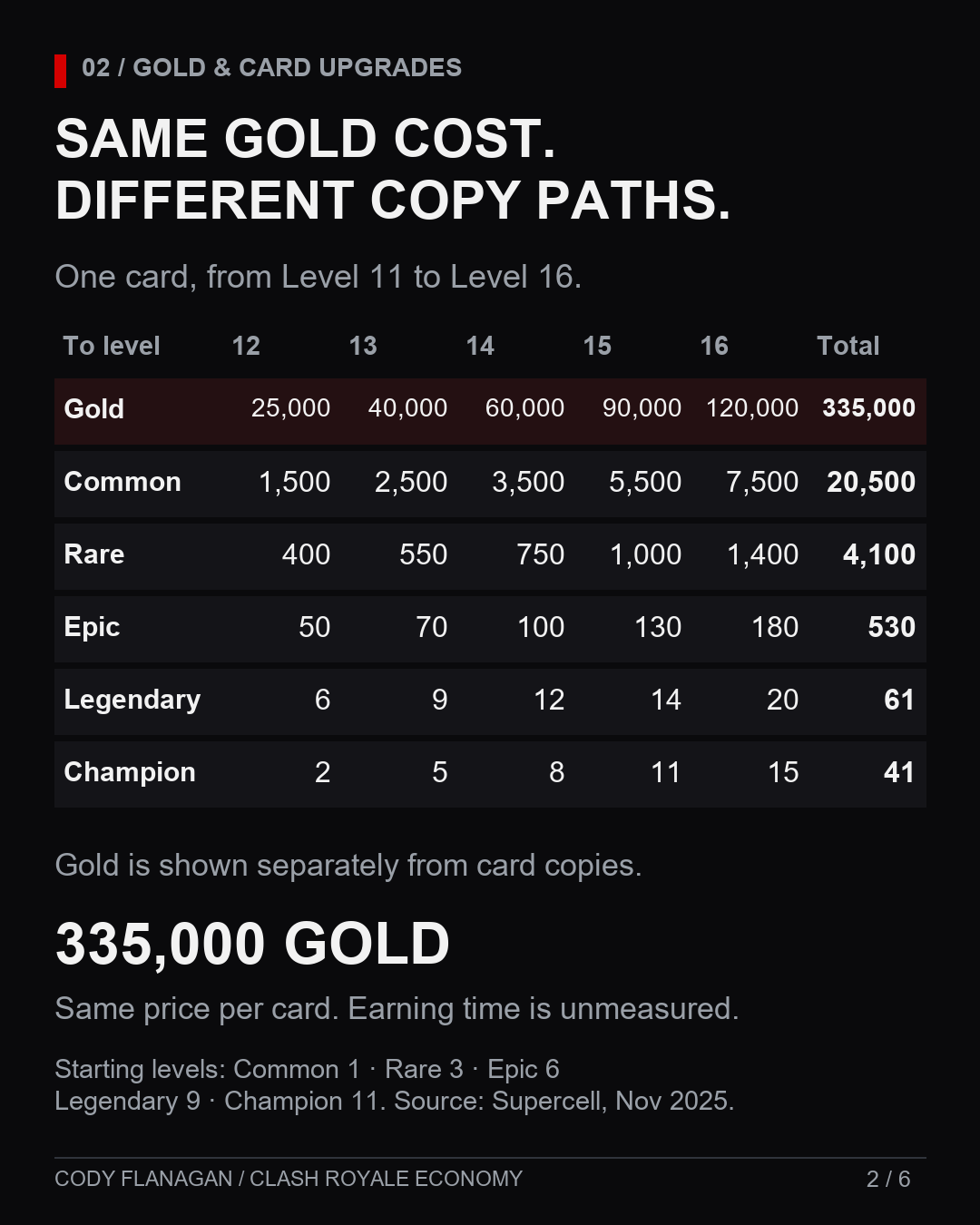
This comparison begins at Level 11 because that is where Champion cards enter the progression ladder and every rarity can finally be compared across the same levels. Taking one card from Level 11 to Level 16 costs 335,000 Gold regardless of rarity, while the copy requirement ranges from 20,500 Common copies to 41 Champion copies. That does not mean the rarities progress equally— the availability of those copies still matters—but it separates the economy's two gates cleanly: Gold sets a shared price while rarity changes the copy requirement. Neither table establishes the time needed to earn those inputs; reward supply and the player's existing inventory also matter.
On my account, those gates have mattered differently over time. Early on, Gold scarcity pushed me to specialize in one deck. Spreading upgrades across the collection would have left me with several incomplete decks instead of one competitive deck. Once that first deck was finished, incoming cards and rewards could begin supporting the next one.
Now, after ten years and with several maxed decks that have remained viable for roughly the last year, I mostly upgrade whatever is waiting. Copies are rarely the limiting input for established cards; they become noticeable again around newly released cards and Champions. Gold still determines how quickly I can finish those upgrades. The cards are playable already, but an unfinished upgrade can limit where I am comfortable using them.
The design creates pressure without establishing a separate paid ceiling. Paying can finish a deck sooner, build more options, unlock new releases earlier, and absorb inefficient upgrade choices. It does not give the same card a higher endpoint. A free player can eventually bring one viable deck to the same maximum level, then widen the collection from there.
For me, the tradeoff changes once the first competitive deck is complete. Scarcity initially gives upgrades a clear order; later, it slows experimentation with cards I already own. That distinction matters when judging the same Gold schedule across different stages of progression.
The table compares one card from Level 11 to 16, using Supercell’s November 2025 requirements. It is neither the full unlock-to-maximum journey nor an earning-time estimate. My account history supplies the stage comparison.
November 2025 upgrade tablesCards and decksShow the upgrade requirements as a text table
| To level | Gold | Common | Rare | Epic | Legendary | Champion |
|---|---|---|---|---|---|---|
| 12 | 25,000 | 1,500 | 400 | 50 | 6 | 2 |
| 13 | 40,000 | 2,500 | 550 | 70 | 9 | 5 |
| 14 | 60,000 | 3,500 | 750 | 100 | 12 | 8 |
| 15 | 90,000 | 5,500 | 1,000 | 130 | 14 | 11 |
| 16 | 120,000 | 7,500 | 1,400 | 180 | 20 | 15 |
| Total | 335,000 | 20,500 | 4,100 | 530 | 61 | 41 |
All columns after Gold are card-copy counts. Natural starting levels: Common 1, Rare 3, Epic 6, Legendary 9, Champion 11.
Chests & Reward Engine
The reward systems that matter most in my normal play are Daily Battle Rewards, events, and the Pass. Battle chests no longer form a separate timed inventory. In April 2025, Supercell removed chest queues, unlock timers, and keys, combined Battle Rewards with daily win rewards, and made the rewards immediate. The current daily loop awards a Magic Lucky Chest on each of the first four wins, Gold across a limited set of wins, and five bonus Crowns for each of the first three battles. Those Crowns advance the Pass, linking daily play to a seasonal reward track.
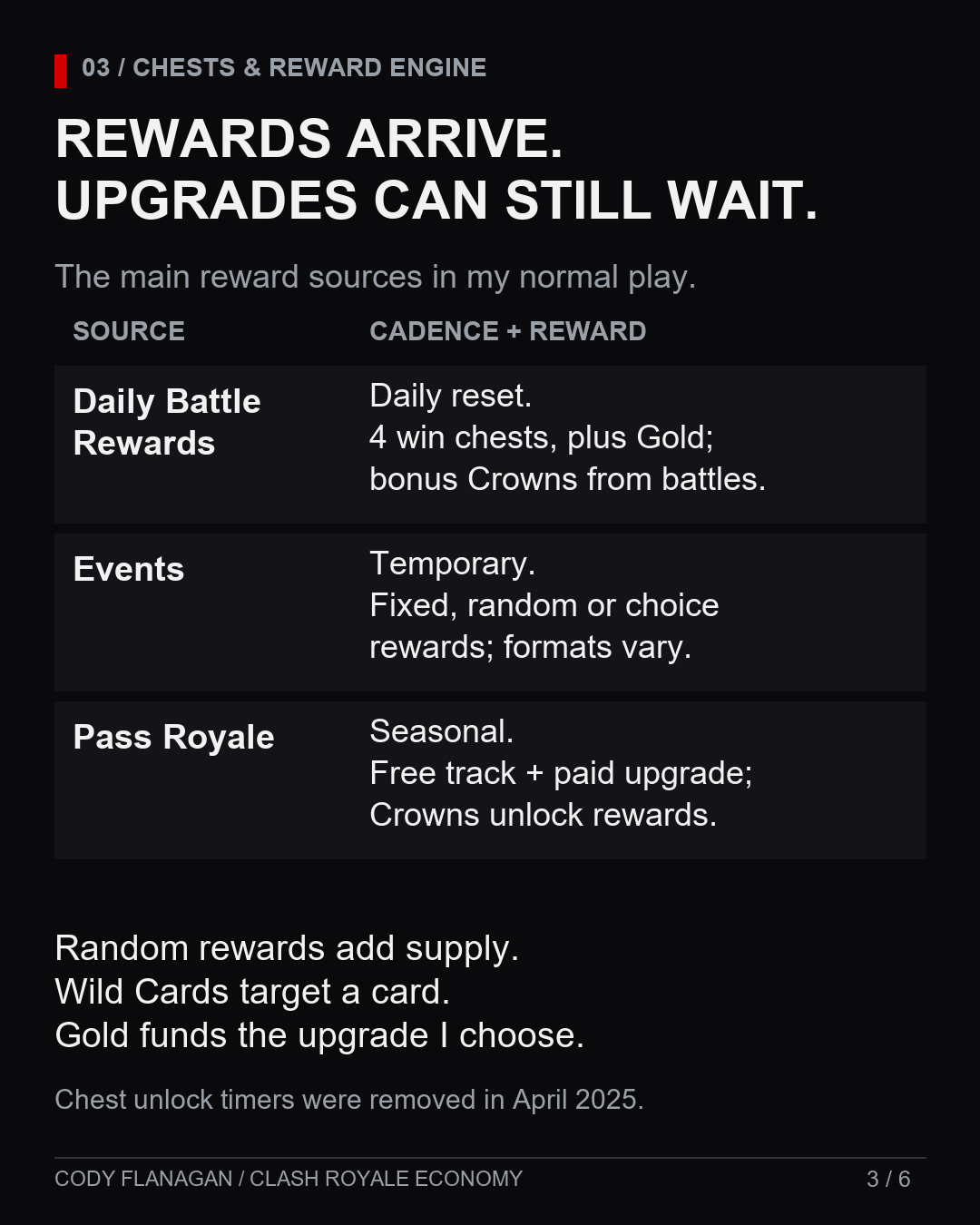
Events are the other meaningful free engine, but their structures vary. Some rewards are fixed, some are random, and some offer a choice, so I would not treat “event rewards” as one consistent payout model. What they share is a timer. Events expire, which makes me prioritize them. The Pass is seasonal, but I finish it through normal play and never feel pressure to complete it. On my account, Trophy Road rewards are negligible beside these sources.
Daily rewards and much of the free Pass are random. On my account, random cards and chest contents usually add another waiting upgrade. Wild Cards let me direct that progress to a particular card. Gold gives me a different choice: which ready upgrade to complete. The constraint is how much Gold arrives, not where I can spend it.
The Pass—counting both the free and upgraded tracks—and Gold-bearing events are my largest Gold sources, depending on the event. Even together, they do not remove the shortage. The economy is far more generous than it was, and removing chest timers made rewards less restrictive, but much of that generosity becomes a backlog of possible upgrades. For me, removing the wait to receive a reward has not removed the wait to afford an upgrade.
Daily reward rules and the removal of chest timers are official facts. Reward priorities, deadline pressure and Gold scarcity describe my normal play.
April 2025 updateDaily Battle RewardsPass RoyalePass & Shop
Pass Royale and the Shop package the same economy in different ways. The free Pass establishes a seasonal baseline through play. The $11.99 upgraded track sits on top of it, combining Gold, Gems, Wild Cards, one mutually exclusive choice, random rewards, and cosmetics. The Shop separates those needs into individual offers and locked sequences, where later offers require buying or claiming the earlier steps. The difference is not just price: the Pass bundles breadth and flexibility, while the Shop asks players to buy one shortage at a time.
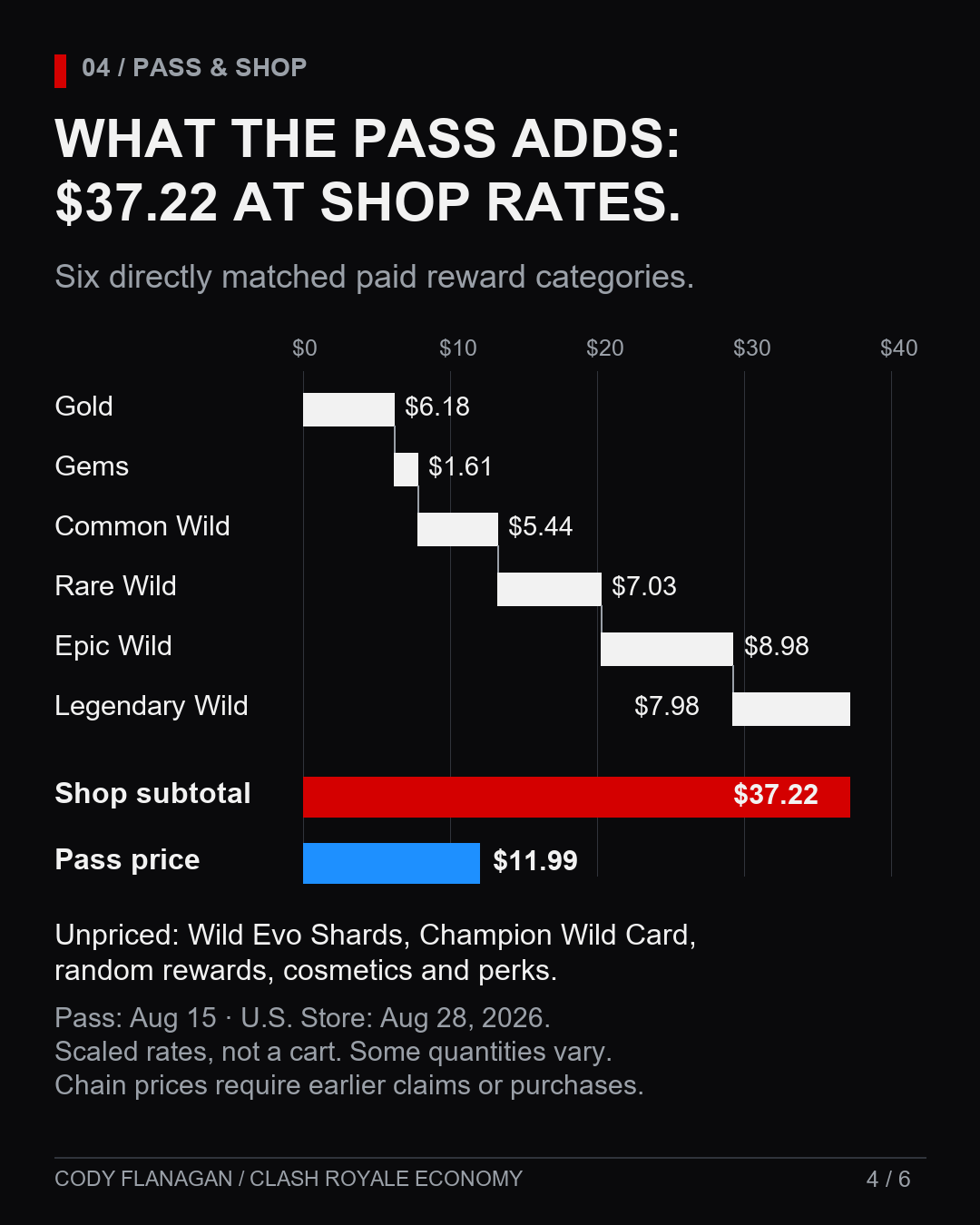
To compare them honestly, I subtract the free track from the upgraded total. In my August 15 Pass snapshot, the paid uplift shown was 310,000 Gold, 225 Gems, six Wild Evolution Shards, 4,100 Common Wild Cards, 705 Rare, 90 Epic, eight Legendary, and one Champion Wild Card, before random cards, cosmetics, or perks. The choice is counted once because its branches are mutually exclusive. These are full-track rewards: buying the upgrade still requires earning Crowns to claim them, so the comparison assumes completion.
Using my signed-in U.S. Supercell Store on August 28, the six directly matched categories total $37.22 at the displayed rates: $6.18 in Gold, $1.61 in Gems, $5.44 in Common, $7.03 in Rare, $8.98 in Epic, and $7.98 in Legendary Wild Cards. The Store's $11.99 Evolution offers were for specific Evolutions, not six flexible Wild Shards, so I leave the Pass's shard choice unpriced. The Champion Wild Card, random cards, cosmetics, and perks also remain unpriced.
This is a dated rate comparison, not a purchasable cart or a claim that these rewards are worth $37.22 to every player. It scales pack prices to the Pass quantities, including fractional packs. Gold used a time-limited special, Gems used the largest displayed pack, and Wild Card prices came from a locked sequence requiring earlier claims or purchases. Account offers vary, and starred Pass quantities depend on choices and chest chances.
The comparison explains why the Pass can feel stronger without proving every Shop offer is poor. It concentrates several bottlenecks into one purchase and preserves agency through choice, so its usefulness can shift with the account. The Shop fragments those needs; Gold-heavy specials can still matter when Gold is the active bottleneck. Because the free baseline remains, paying accelerates and broadens the same progression system rather than creating a separate reward economy.
Pass quantities come from my August 15, 2026 screenshots; prices come from my signed-in U.S. Store on August 28. Public links explain the mechanics, not those account-specific prices. This comparison assumes full-track completion and counts one reward-choice branch.
Pass RoyaleShop offersMagic ItemsShow the Pass comparison calculation
| Resource | Paid uplift | Store anchor | Scaled amount |
|---|---|---|---|
| Gold | 310,000* | 200,000 / $3.99 | $6.18 |
| Gems | 225 | 14,000 / $99.99 | $1.61 |
| Common Wild Cards | 4,100* | 1,500 / $1.99 | $5.44 |
| Rare Wild Cards | 705* | 300 / $2.99 | $7.03 |
| Epic Wild Cards | 90* | 40 / $3.99 | $8.98 |
| Legendary Wild Cards | 8* | 5 / $4.99 | $7.98 |
| Six-category subtotal | $37.22 | ||
*Displayed quantities can vary with choices and chest chances. Gold used a limited special; Gems used the largest displayed pack; Wild Card anchors were steps in a locked sequence. Flexible Wild Evolution Shards, Champion Wild Cards, random rewards, cosmetics and perks are unpriced.
Progression Ceiling & Catch-Up
Gold and card copies determine how quickly a deck reaches maximum level. The remaining economy question is what stays unequal after two players finish the same eight cards. At that point, the card-level gap for that deck is zero: Level 16 is Level 16 whether the upgrade was earned or accelerated. This is card-level convergence, not proof of equal battlefield power or whole-account completion. I do not have the earning-rate data to attach a catch-up time to it.
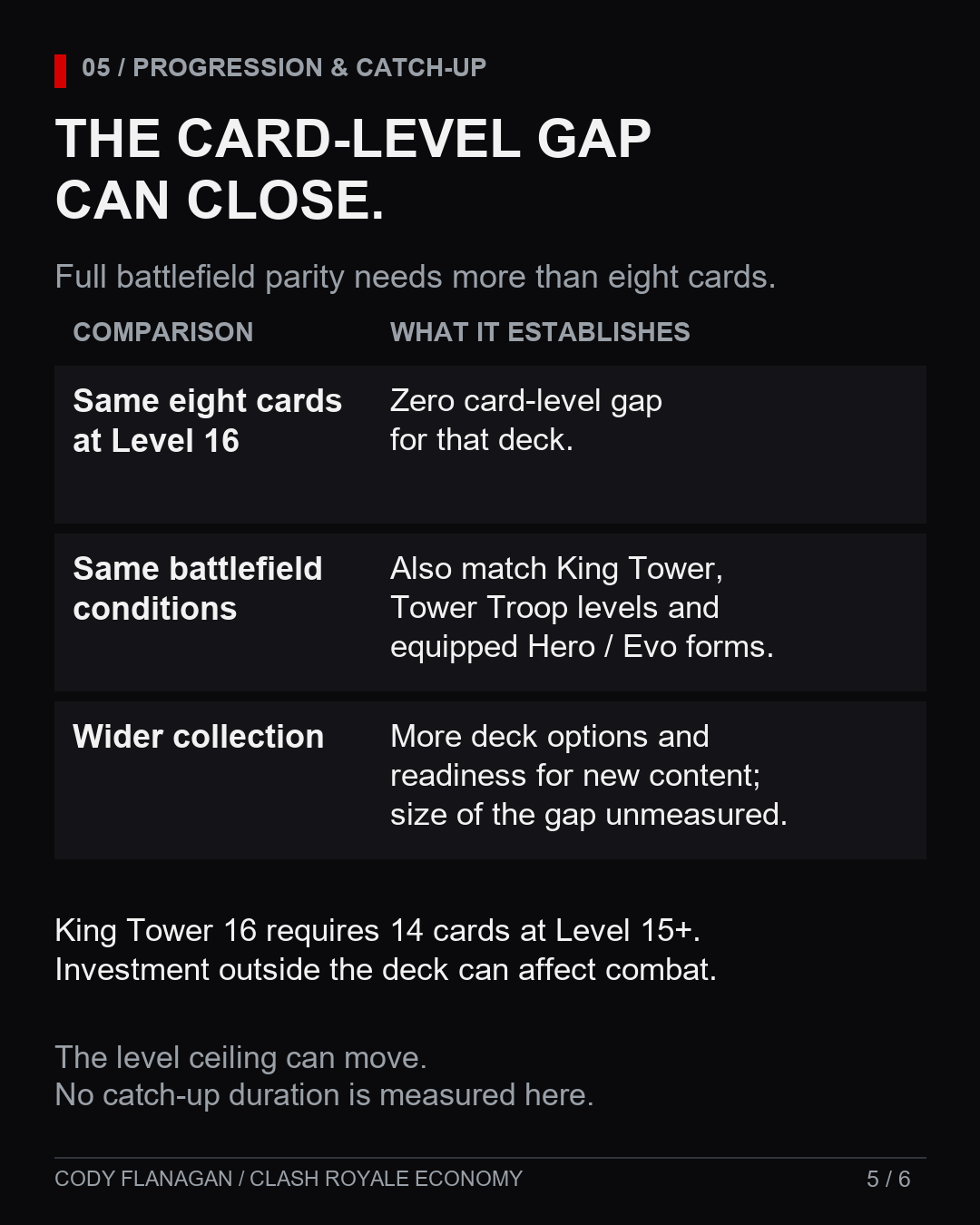
A fair battlefield comparison must also match the relevant King Tower and Tower Troop levels, plus equipped Hero and Evolution forms. These can affect combat beyond the levels of the eight cards. King Tower Level 16, for example, requires fourteen cards at Level 15 or higher. Some investment outside the chosen deck therefore contributes to its battlefield strength.
Once those conditions match, a wider collection still gives the player more options: another finished deck, a new release ready to use, or an easier response to a balance change. Paying can acquire those options earlier. That is a real advantage, but it does not increase the card-level ceiling of the already matched deck.
The endpoint can also move. Supercell described Level 15 as the maximum in 2023, then introduced Level 16 in 2025. New cards, Heroes, and Evolutions add more progression without making an individual card's path infinite. The result is a repeating pattern: payment can open a lead, focused free progression can close it on one deck, and a wider collection or a new frontier can preserve or reopen that lead elsewhere.
That is the economy's fairness trade: a free player can reach the same card-level endpoint while breadth and access remain valuable. Full combat parity requires the additional conditions above. Catch-up is meaningful, but equal levels alone are too narrow a test of fairness.
Official rules establish card, tower and form progression. The paid-breadth and catch-up judgments are my interpretation; no progression duration or whole-collection parity is measured.
November 2025 upgrade tablesKing Tower levelsTower TroopsHeroesCard EvolutionVerdict
On my account, Clash Royale gives me more ready upgrades than I can afford. Daily Battle Rewards, events, and the Pass keep cards, Wild Cards, shards, and Gold moving into the account. Targeted resources let players choose what to pursue. For standard card levels, however, copies only make an upgrade available. Gold supply limits how many I can complete, while I choose which ones.
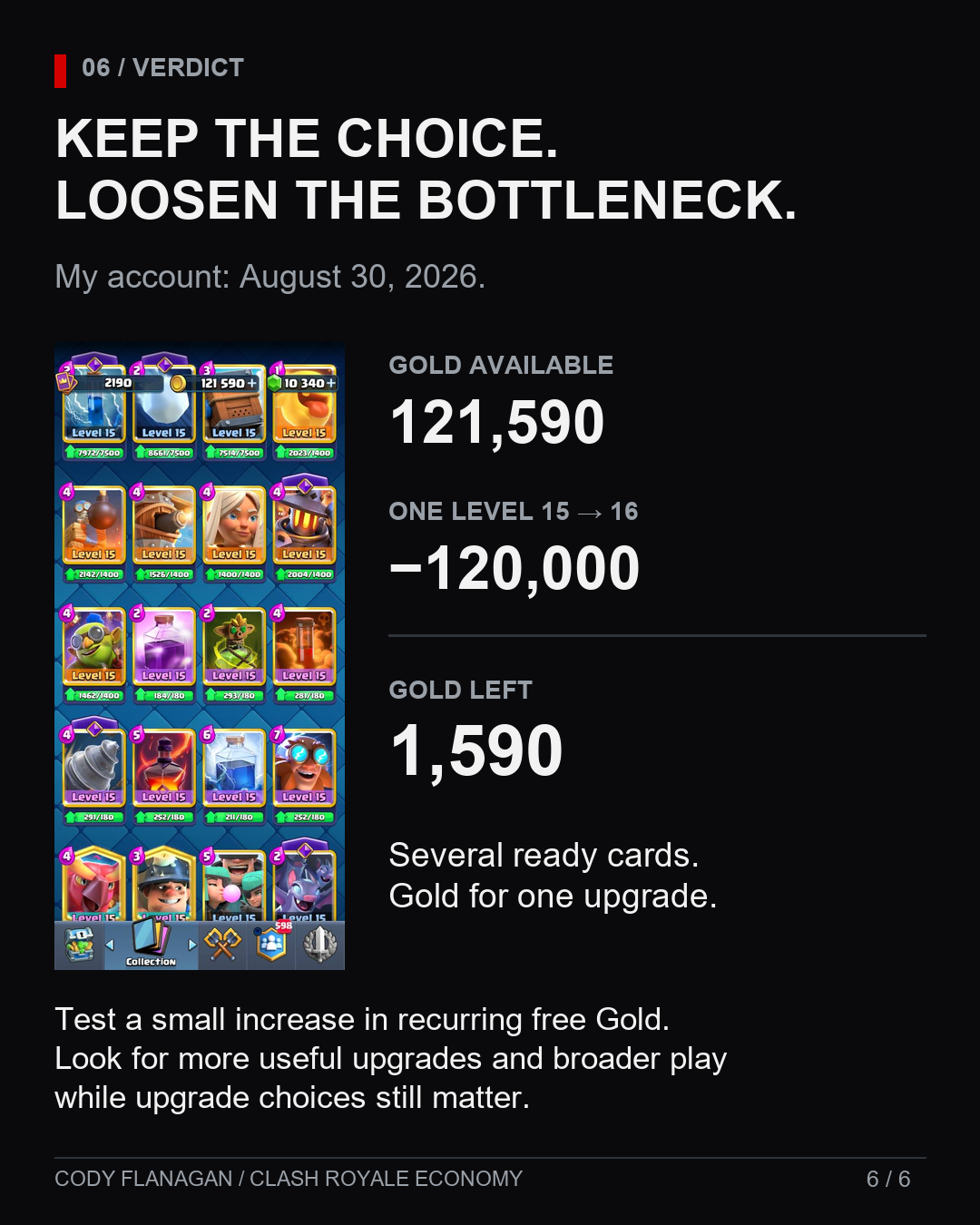
That scarcity does different work at different stages. Early on, it makes specialization meaningful. Limited Gold pushed me to finish one competitive deck instead of scattering upgrades across several incomplete ones. Later, when copies accumulate and more cards are ready, the same constraint becomes harsher. Another random reward can expand the backlog without expanding the usable collection. Receiving more rewards can therefore feel generous without giving me many more competitive options.
I would keep the Gold bottleneck, but loosen it. Because it still makes priorities matter, a large increase could erase useful pressure along with the frustration. I would test a small increase in recurring free Gold against an unchanged group, comparing earlier and later account stages separately. I would track completed copy-ready upgrades, the remaining backlog, and whether players actually use a wider range of cards or decks. Success would mean more useful upgrades and broader play while Gold still forces priorities. If Gold only accumulates, deck use stays narrow, or every upgrade becomes automatic, I would reduce or rethink the increase. This is a proposed test, not a measured result or a claim that I know the right amount.
What I would copy is the breadth of reward routes, the targeted resources, and the reachable endpoint for one competitive deck. What I would change is how tightly one shared resource controls the wider collection. On my account, that control is tuned a little too tight: I would keep the choice and loosen the bottleneck.
The image is my August 30, 2026 Collection snapshot. Its subtraction is a dated example. The recommendation and comparison design are proposals, not population findings or a measured optimum.
November 2025 upgrade tablesIndependent study by Cody Flanagan. Account observations: August 2026; revised September 7, 2026. Research, editing and visual production assisted by AI. No affiliation with Supercell.